Buyer Self-Service

Buyers act independently.
Buyer management gains time.

The biggest time drain in buyer management isn't the complexity of decisions — it's the sheer volume of queries. 'Which tiles did we choose?' 'Is this still in budget?' 'When do we need to decide?' Every one of these questions ends up with the buyer management team — unstructured, without prioritisation, time-consuming. The oneLynk buyer self-service portal changes this fundamentally.

  • Select fitout options digitally — structured and guided through the selection process
  • Check budget status in real time — always know what is available and what surcharges cost
  • Grant approvals digitally — with timestamp, legally binding, traceable at any time
  • Access documents — plans, contracts, protocols — always the current version
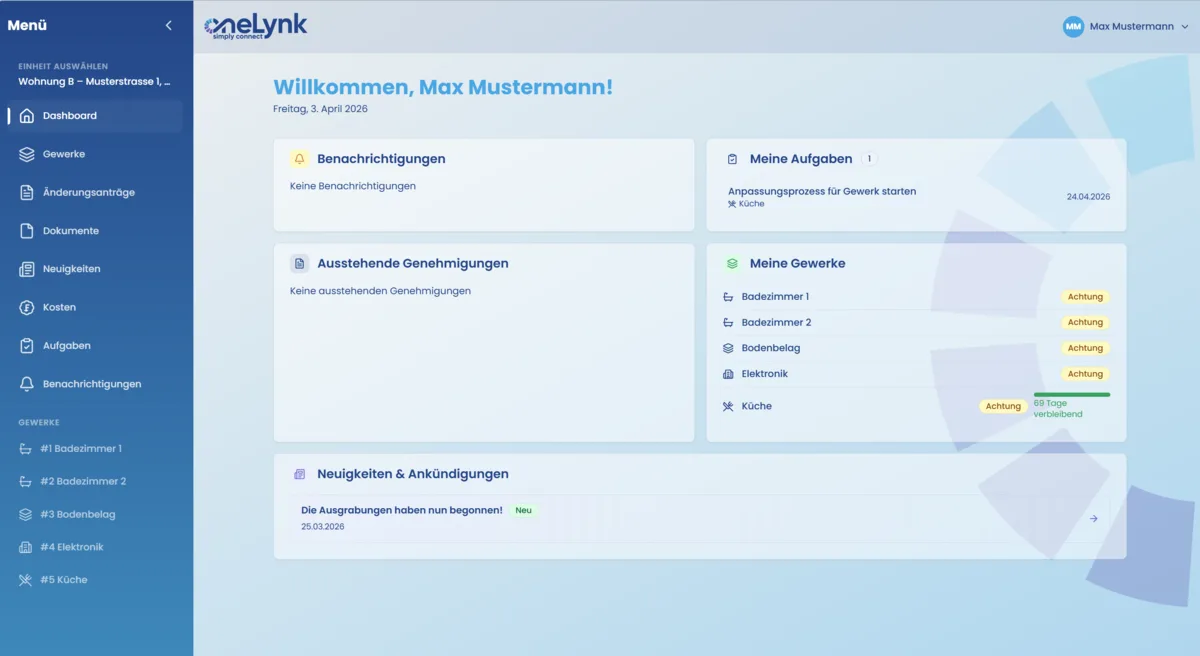
Buyer dashboard: options selection, budget overview, open decision statuses
The difference

What changes concretely.

Today
With oneLynk
Email chain for kitchen approval — 7 emails, 3 days
Digital approval with one click — timestamp automatic
Decision status spreadsheet — updated manually every day
Real-time dashboard — automatically current, visible to all parties
Phone call: 'Did you receive our email?'
Automatic reminder for open deadlines
Handwritten note in the selection protocol
Digital protocol — immediately visible to all
'Which version was approved?' — nobody knows for certain
Complete, immutable protocol with version history
FOR PRACTICAL USE

When buyers act independently, buyer management gains time.

When buyers answer 80% of their own questions, the work of buyer management shifts fundamentally. Instead of reacting to incoming queries, work becomes proactively managed. Instead of handling unfiltered individual emails, there are structured tasks. And instead of communicating the same status information over and over, it happens automatically. The result: more projects with the same staff, less additional effort during the fitout phase, and buyers who are more satisfied — because they are informed.

«The biggest time gain was that our buyers could view their budget status at any time. The number of calls decreased significantly in the first few weeks.»

From practice: buyer manager, Swiss general contractor
Frequently asked questions

About Buyer Self-Service in Residential Construction

What is Buyer Self-Service in residential construction?
Buyer self-service in residential construction refers to digital processes where property buyers can make their fitout decisions independently — without contacting the buyer management team for every question. This includes selecting kitchens, bathroom fittings and flooring, checking available budget in real time, and granting digital approvals. When implemented well, this demonstrably reduces the coordination effort for buyer managers by up to 80%.
What fitout decisions do property buyers typically make?
Over the course of a new-build project, buyers make a range of fitout decisions: kitchen installation, bathroom fittings, flooring, paintwork and electrical connections. Depending on the project, built-in wardrobes, garage fittings and other items may also be included. The fitout phase typically lasts 4–6 months and is the most time-intensive stage of buyer management — with 10 to 30 individual decisions per residential unit.
How can buyer management be made digital and legally compliant?
Legally secure digital buyer management requires four elements: clear identification of the buyer (individual login, verified email address), immutable documents after approval, a complete log with date, time and user ID, and transparent information for the buyer about exactly what was approved. For the vast majority of buyer decisions, a well-documented digital approval is legally sufficient.
What are the most common problems in buyer management on new-build projects?
The most common problems are: uncontrolled communication channels (email, phone, WhatsApp running in parallel), lack of centralised documentation of decisions and approvals, unclear cost transparency for special requests, deadlines for fitout decisions communicated too late, and insufficient evidence gathering in case of disputes. These problems almost always arise at the interfaces between buyers, buyer management and suppliers.

50% less effort — see it in your project.

We show you oneLynk in 30 minutes — concrete, using your projects.