Structured Workflows

Every decision has a place.
Every step is documented.

Change requests, quotes and approvals run through a structured process in oneLynk. Every task has a status. Every approval is documented with a timestamp. 80–90% less email traffic.

  • Capture change requests in a structured way — nothing gets lost, nothing stays unresolved
  • Quotes directly in the system — supplier uploads, buyer management reviews, buyer approves
  • Digital approvals with timestamp — legally binding, traceable at any time
  • Status at a glance — every task: Initiated, In Progress, Awaiting Approval, Completed
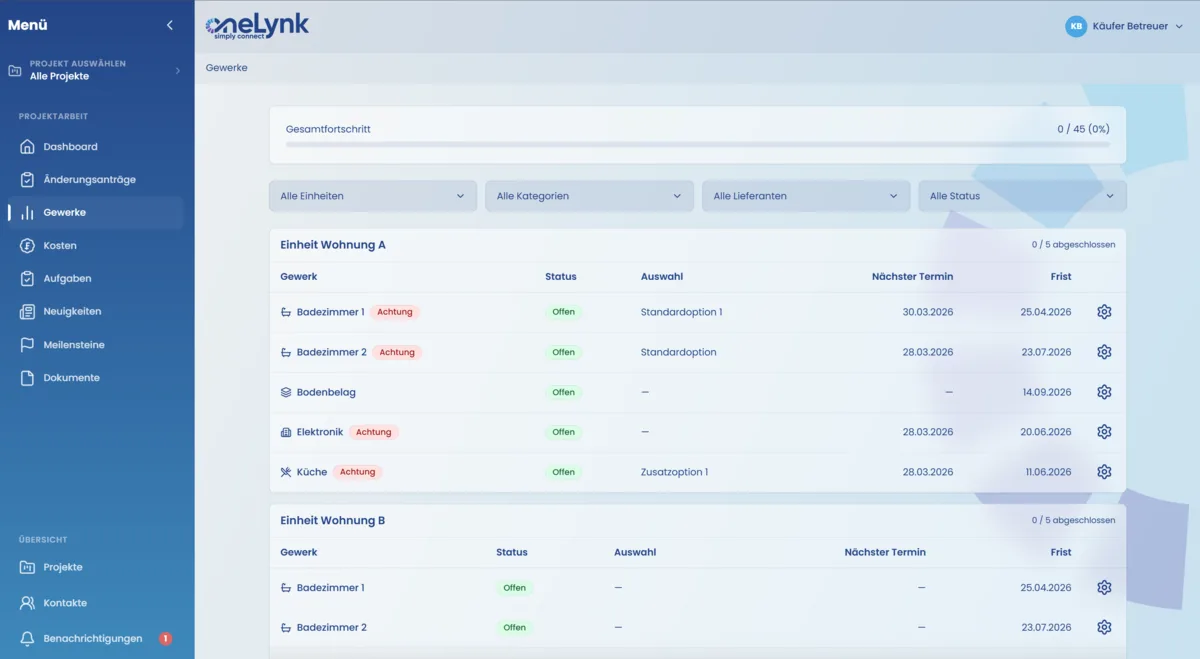
Workflow status dashboard showing all units and their current decision stage
The difference

What changes concretely.

Today
With oneLynk
Change request by phone — documented nowhere
Request captured in the system in a structured way — immediately visible to all
Quote by email — buyer manager searches for the right version
Offer in the system uploaded — versioned, directly forwardable to buyer
Verbal approval — no proof in case of dispute
Digital approval with timestamp — immutably documented
Status check by phone call: 'Where are we with the kitchen?'
Status visible at any time — for buyer management, buyers and suppliers
Handover: 'We never agreed to that.'
Complete decision history available at handover
FOR PRACTICAL USE

What happens when every decision is documented.

The core workflow in oneLynk follows five clearly defined phases: schedule appointment, capture request, obtain quote, grant approval, document completion. Each step is visible in the system — for buyer management, buyers, and suppliers, each with the information relevant to them. This reduces queries, prevents misunderstandings, and protects all parties in questions of liability. Instead of emails that get buried and spreadsheets that go stale, every task has a clear status.

«Before, we regularly argued at handover about what exactly had been agreed. Now we just show the documented decision history in the system.»

From practice: buyer manager, Swiss general contractor
Frequently asked questions

About Structured Workflows in Residential Construction

How does a change request work in oneLynk in practice?
The change request is captured in a structured way in the system by either the buyer or the buyer manager. The supplier is notified, creates a quote and uploads it. The buyer manager reviews it and submits an order amendment to the buyer for approval. The buyer can approve, reject or ask follow-up questions. Upon approval, the budget is automatically updated and execution begins — everything documented, everything traceable.
Are digital approvals in buyer management legally binding?
Digital approvals in oneLynk are documented with a timestamp and user ID. For the vast majority of fitout decisions, a well-documented digital approval is legally sufficient. For questions about specific legal requirements, we recommend consulting your legal counsel or notary.
Can multiple change requests run in parallel?
Yes. Each residential unit can have multiple active tasks simultaneously, each with its own status. Buyer management sees all open tasks in the overview and can filter by status and urgency.
What happens if a buyer rejects a change request?
The workflow returns to the processing phase. The buyer manager contacts the buyer, clarifies the next steps and either restarts the process or closes it — the entire history remains documented in the system.

50% less effort — see it in your project.

We show you oneLynk in 30 minutes — concrete, using your projects.